
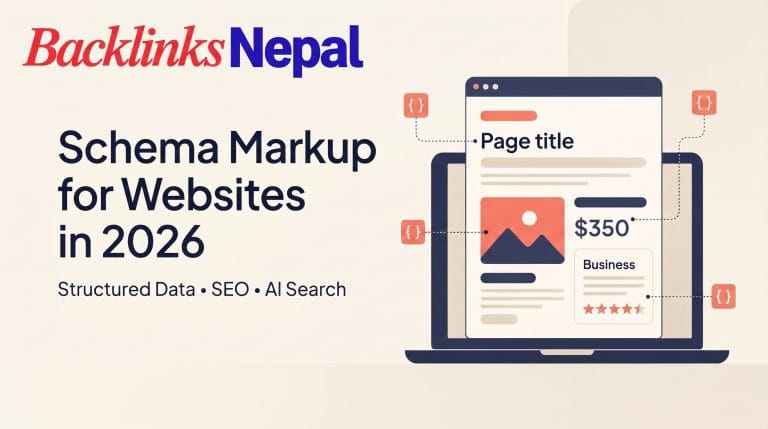
If you have ever used Google Search and have encountered a business that has star ratings, working hours, or an FAQ drop-down menu, all displayed directly on Google, then it has made use of schema markup. It is perhaps the easiest way to improve a website from a technical standpoint, and in 2026, it becomes even more important because artificial intelligence can understand it.
Quick Answer
Schema markup is a coding form of structured data that you insert into a webpage to help the search engine or AI system interpret it more precisely. Including schema markup for websites in 2026 lets webpages qualify for rich snippets, FAQ results, and citation in AI-generated responses, although it won’t necessarily improve rankings.
What Exactly Is Schema Markup?
The vocabulary is schema markup, which comes from schema.org. Rather than having the search engine make a guess about whether or not something on the page is a price or the address of the business, schema markup will tell you exactly that.
The majority of schemas use the language of JSON-LD (JavaScript Object Notation for Linked Data). It sits within your page’s HTML script but does not affect its appearance in any way. Two more languages exist for schemas, Microdata and RDFa, which technically still work, but Google does not recommend them. All SEO WordPress plugins use JSON-LD instead.
How Does Structured Data Help SEO?
This is the question most site owners actually want answered, so it deserves a direct response.
Structured data does not act as a ranking factor by itself. What it does is make your page eligible for enhanced results that plain HTML cannot get:
- Star ratings and review information where eligible
- Breadcrumb trails showing your site’s structure
- Product information such as price and availability where eligible
- Business information that can help Google understand your organization
Higher visibility in search results generally leads to a better click-through rate. That is where the indirect SEO benefit comes from. A listing with a star rating and a visible answer usually pulls more clicks. A plain blue link in the same position gets fewer.
Schema Markup and AI Search Visibility
Search has changed. Tools like Google AI Overviews, ChatGPT, and Perplexity now generate direct answers instead of just listing links, and this is where structured data plays a second, newer role.
AI systems favor content that is easy to verify. A paragraph of plain text requires the model to interpret meaning and infer facts, which carries a higher risk of error. A page with clear structured data, an FAQPage marking out a question and its answer, or an Article schema stating the author and publish date, gives the AI system a fact it can lift with confidence.
This connects directly to Generative Engine Optimization (GEO): the more explicitly your page states what it is, who wrote it, and what it answers, the more likely an AI system is to cite it rather than a competing page that buries the same information in prose.
The Schema Types Worth Prioritizing
Not every schema type is worth your time. For most Nepali businesses and content sites, these five cover almost every use case:
| Schema Type | Best Used For | Key Fields to Include |
|---|---|---|
| LocalBusiness | Shops, clinics, agencies, service providers | Name, address, geo coordinates, opening hours, phone number |
| Product | Ecommerce and retail listings | Price, availability, currency, product images |
| FAQPage | Service pages, how-to content, guides | Question and answer pairs written exactly as they appear on the page |
| Article | Blog posts and news content | Headline, author, publish date, featured image |
| BreadcrumbList | Any multi-level site (blogs, stores, service sites) | Page hierarchy from homepage down to the current page |
Applying These Schema Types to Your Business
A note for local businesses: if you run a shop or service in Nepal, list your priceRange in NPR, keep your map coordinates accurate (many Kathmandu addresses do not follow a standard format, so pinpointing the exact location matters), and add your Nepali business name as an alternateName where relevant.
A note for online stores: a Product schema is only useful if the data stays accurate. If your site shows “In Stock” through schema markup while the product has actually sold out, that mismatch damages user trust and can affect how search engines treat your listings over time. Retailers such as Newish Fashion, for example, benefit from product schema that reflects real-time price and stock status rather than a static value that someone sets once and never updates.
A note for tourism and event-based businesses: trekking companies, tour operators, and event organizers should look at Event schema for anything with a fixed date, using the ISO 8601 date format and linking to a specific venue or itinerary page. A tour listing site like Discover Himalaya Nepal is a good example of a business where event and destination schema would directly support how trips show up in both traditional and AI-driven search results.
How to Add Schema Markup on a WordPress Website
You do not need to write raw JSON-LD by hand to use schema markup for websites design in 2026. Most WordPress sites can implement it through existing tools:
- Use an SEO plugin. Rank Math and Yoast SEO both generate JSON-LD automatically for posts, pages, products, and FAQs, with a visual editor so you are not writing code directly.
- Match the schema type to the page. A service page should not use generic Organization markup when a more specific type like LocalBusiness or Article exists. More specific types perform better in rich results.
- Keep the schema in sync with the visible page. Whatever you state in the schema, price, author name, FAQ answers, must match what a visitor actually sees on the page. Mismatches are a common cause of lost rich results.
- Validate before publishing. Run the page through Google’s Rich Results Test and the Schema.org validator. Both are free and take under a minute per page.
- Monitor Search Console after launch. The “Enhancements” section of Google Search Console reports on structured data health across your site and will flag errors if something breaks after a theme or plugin update.
Your website might not run on WordPress. If so, ask whoever handles your hosting or development one question. Does the HTML code include the JSON-LD directly, or does JavaScript add it later? The first method is far more reliable for crawlers and AI programs.
Common Schema Markup Mistakes to Avoid
- Leaving fields empty or setting them to null instead of removing them when data is unavailable.
- Using string values where the schema requires an object, such as writing an address as plain text instead of a structured PostalAddress.
- Relative image paths in schema, which fail validation. Image URLs must always be complete and absolute.
- Marking up content that is not visible on the page. Google treats this as manipulative and can suppress rich results sitewide.
- Copying a generic template without adapting it, which leaves your business looking like a generic listing instead of a specific, well-defined entity.
Frequently Asked Questions
Does schema markup improve Google rankings?
No, not directly. Schema markup is not a ranking factor, but it makes your listing eligible for rich results, which typically improves click-through rate and can support better performance over time.
What is the difference between schema markup and rich snippets?
Schema markup is the code you add to a page. A rich snippet is the enhanced search result, stars, FAQs, breadcrumbs, that can appear because of that code. One is the input, the other is the possible outcome.
Should I use JSON-LD or Microdata?
Use JSON-LD. It is Google’s recommended format, keeps structured data separate from your visible page content, and is far easier to maintain, especially on WordPress sites where themes and plugins update frequently.
Which schema type should a small business in Nepal start with?
LocalBusiness schema first, since it directly supports local search visibility. FAQPage is a strong second step for any service page that already answers common customer questions.
How do I check if my schema markup is working?
Run the live page through Google’s Rich Results Test. It will show which structured data it detected and flag any errors that would block a rich result from appearing.
Setting up schema markup takes just a few hours. It keeps rewarding you as search results and AI-based answers develop further. Use the right schema markup on every page. Keep it accurate. This positions your website better as more traffic shifts to AI-based answers.
Useful SEO Tools from Backlinks Nepal
To support your SEO and digital marketing efforts, explore our free tools built for Nepali website owners and marketers:
- Image Converter convert images between formats for faster-loading pages
- Contrast Checker check color contrast for accessibility and design clarity
- Security Header Checker scan your site’s HTTP security headers
- YT Thumbnail Downloader grab high-quality YouTube thumbnails instantly
- QR Code Generator create QR codes in multiple formats for free