
Quick Answer
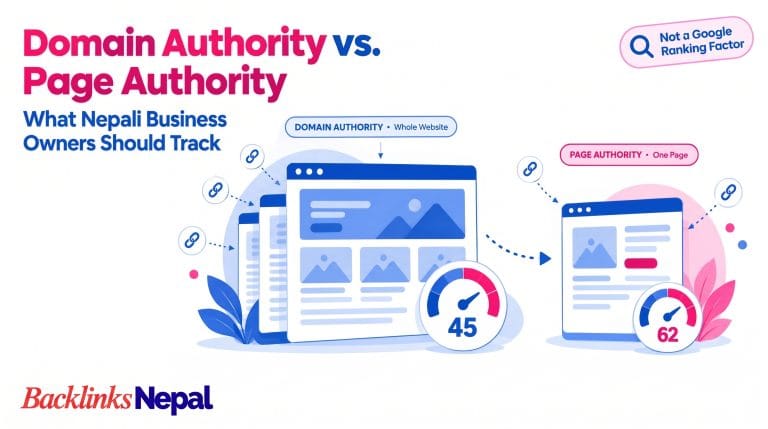
Domain Authority (DA) gives your whole website a score based mostly on the links pointing to it from other sites. Page Authority (PA) does the same thing for one single page. Google doesn’t create or use these scores. They’re useful for comparing your site with others, but you shouldn’t treat them as goals.
What Domain Authority and Page Authority Actually Measure
Domain Authority is a metric that predicts your website’s ability to rank high on search engines. It is calculated based on the number of other websites linking to your website and the quality of those websites.
PA is calculated the same way as DA, but it looks at only one page. This means your website may have a certain DA, while a single blog article with lots of quality backlinks can have a much higher PA than your other pages.
SEO companies created both scores using their own formulas. Google doesn’t calculate them, doesn’t publish them, and doesn’t rank websites based on them. Think of them as a rough guide, not a target.
Why the Difference Matters for a Nepali Business
Knowing which score to look at helps you make better decisions.
Comparing yourself to competitors. DA shows you how your website compares to other businesses in your field. For example, if you run a travel agency in Thamel, you can check how your site stacks up against other agencies.
Checking a single page. PA is more useful when you want to know if one landing page or blog post has a good chance of doing well.
Deciding on a guest post. Before you write a guest post for another website, both scores give you a quick idea of how strong that site is. But also ask yourself: is this website related to my business? That matters just as much.
Watching your progress. Checking your score every few months and seeing which way it’s moving tells you more than looking at one number on one day.
Domain Authority vs. Page Authority: Side by Side
| Factor | Domain Authority (DA) | Page Authority (PA) |
|---|---|---|
| What it measures | Link strength of the whole website | Link strength of one page |
| Mainly based on | How many good links point to the website | How many good links point to that page |
| Best used for | Comparing your site with competitors | Checking how strong one page is |
| Does Google use it for ranking? | No, it’s a score from SEO tools | No, it’s a score from SEO tools |
How These Scores Actually Move
Both scores go up for the same reason: other websites linking to yours. The best links are the natural ones, where another website links to you because your content helped their readers. Reaching out to related websites one by one, with a real person writing each message, works much better than paying for links on random low-quality sites.
Your old links should be cleaned up as well. This is called a backlink audit, and it means going through your existing links to find any that are spammy, irrelevant, or harmful to your website. In other words, you protect the score you already have, instead of only trying to get new links.
Common Mistakes to Avoid
Thinking Google uses the score. It doesn’t. The score is an estimate made by an SEO tool, and Google has nothing to do with it.
Making the score your goal. A high number means nothing if you aren’t getting visitors or useful links. Your business grows from customers, not from a score.
Mixing up DA and PA. A website with a high DA can still have weak pages, and a website with a low DA can have one very strong page.
Expecting quick results. These scores change slowly as you earn links over time. If an agency promises to raise your DA in a few weeks, be careful.
What to Actually Track
- Your score over time, instead of one number on one day.
- Where your links come from, and whether those websites are related to your business.
- Your Google rankings and website visitors for the keywords your customers search for.
- Bad or spammy links, which you can find by doing a backlink audit every few months.
Frequently Asked Questions
What is Domain Authority?
It’s a score from SEO tools that shows how strong your whole website is, based mostly on the links pointing to it.
What is Page Authority?
It’s the same kind of score as DA, but for one page instead of the whole website.
Is Domain Authority a Google ranking factor?
No. DA and similar scores like Domain Rating (from Ahrefs) are not used by Google to rank websites. Use them as a rough guide only.
How do I increase Domain Authority?
Get other related websites to link to yours. The best way is to create helpful content and reach out to websites in your field personally. A backlink audit also helps by finding bad links that might be pulling your score down.
Should a small business in Nepal care about DA and PA?
They’re handy for comparing your website with competitors and for checking guest post opportunities. But don’t make them your main goal. Your Google rankings, website visitors, and the quality of your links matter much more than the score.
Conclusion
Domain Authority and Page Authority are helpful for comparing websites and checking link opportunities. But Google doesn’t use them, so chasing a higher number won’t help on its own. Instead, watch how your score changes over time, make sure your links come from related websites, and remove any spammy links you find. If you’re not sure where your website stands right now, a backlink audit is a good place to start.