
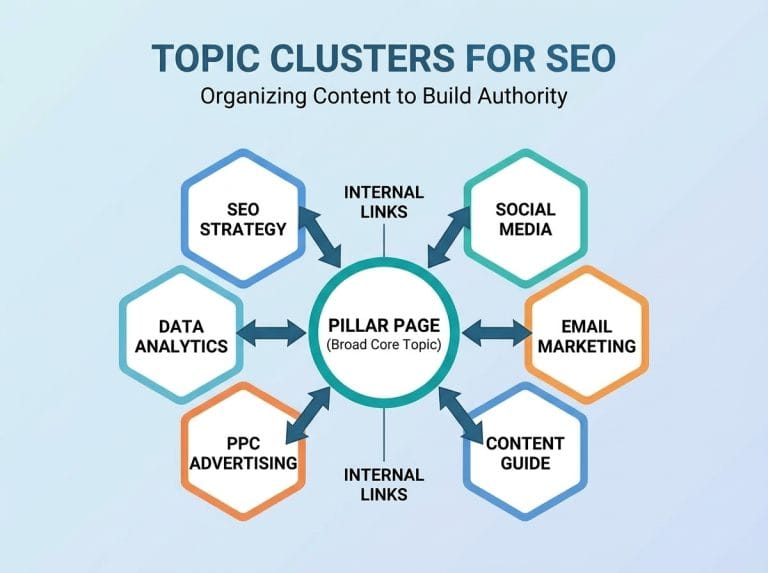
A topic cluster is a group of pages on your website that talk about the same big subject and link to each other. You have one main page that gives a broad overview, and several smaller pages that go deep into related subtopics. All of them are connected with internal links.
If you run a business in Nepal, or you are targeting customers in Nepal, this structure helps Google understand what you actually know a lot about. Instead of publishing random blog posts, you show you have covered a subject properly. That helps you rank for more keywords and build trust.
How a topic cluster is set up
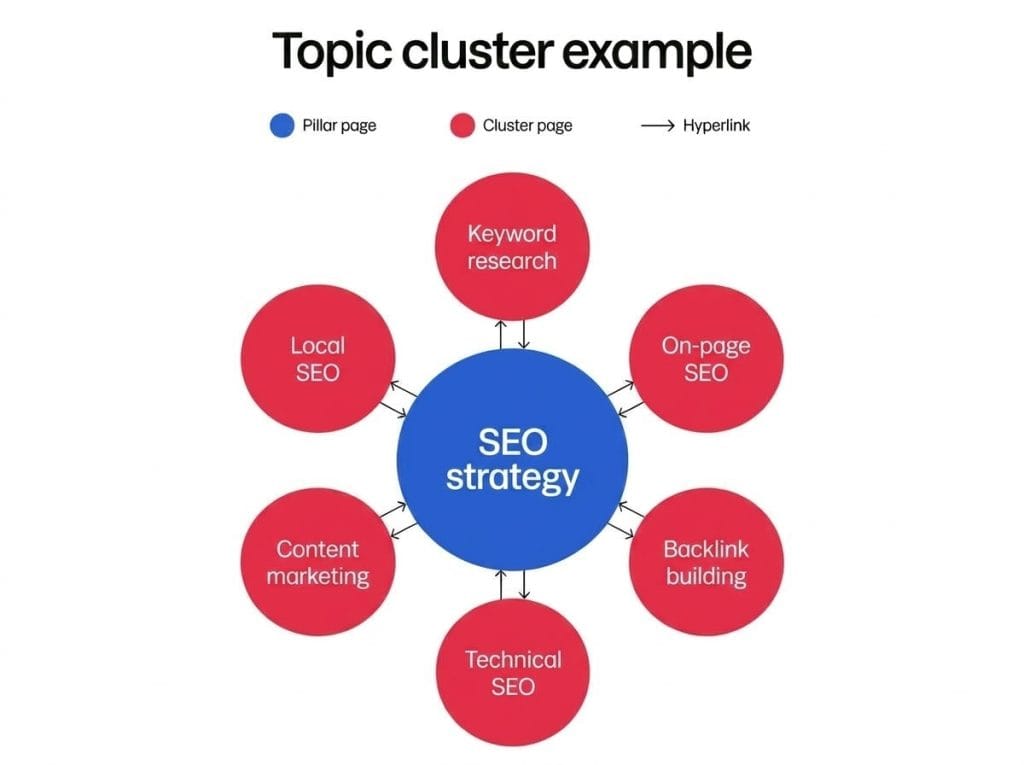
Think of it like this. The pillar content is the center. It answers the main question in a wide way. For example, “complete guide to link building for Nepali businesses” could be a pillar page.
Then you have cluster content. These are the supporting pages. Each one takes one part from the pillar and explains it fully. So you might have separate pages for “how to get backlinks from local directories”, “how to write outreach emails that work in Nepal”, or “how to check if a backlink is good”.
The last part is internal linking. You link from the pillar page to every cluster page, and from every cluster page back to the pillar. Sometimes cluster pages also link to each other when it makes sense. That way both readers and Google can move around and see how everything fits together.
Why it helps your SEO strategy
When you only publish one post about a subject, Google sees one page. When you publish a cluster, Google sees many quality pages about the same area. You can rank for more related searches, not just one keyword.
It also builds what is called topical authority. If someone searches for help with link building and finds you have a full set of guides, not just one short post, they are more likely to trust you. Google looks for that kind of experience and trust too.
And from a practical side, your site becomes easier to use. People land on the pillar, find the exact piece they need, click through, and stay longer. Good content marketing is not just about writing more, it is about organizing what you write so people can use it.
For teams in Nepal trying to grow with backlinks, clusters also make outreach simpler. When your content is grouped and thorough, other websites are more willing to link to it as a useful resource. You can learn more about that approach in our Blog.
How to build a topic cluster without overcomplicating it
1. Pick one core topic you can own
Start with what matters to your business. What do your customers ask about? What have you already written that got some traffic? What are competitors in Nepal covering? Your core topic should be broad enough to split into 5 to 10 smaller pieces, but not so broad that you cannot finish it. “SEO for small hotels in Kathmandu” works better than just “marketing”.
2. Do simple keyword research
Look for how people actually search. You do not need expensive tools at first. Check Google autocomplete, People Also Ask, and the related searches at the bottom of the page. Note the questions that show informational intent, like “how to”, “what is”, “best way to”. These make good cluster pages.
3. Plan your pillar and your clusters
Your pillar page should answer the big question and mention all the subtopics you will cover. Each cluster page should focus on one subtopic and go deeper than the pillar. Write down the titles first. For example:
- Pillar: What is a topic cluster? A simple guide for Nepali businesses
- Cluster: How to choose pillar content ideas from your own services
- Cluster: How to write cluster content that answers real customer questions
- Cluster: How to add internal linking that helps readers, not just Google
4. Write for people, then link them
Start with the pillar page so you have the map. Then create the cluster pages one by one. As you publish, add links. Use normal anchor text that tells the reader what they will get, like “guide to checking backlink quality” instead of “click here”. Do not force links where they do not help.
If you want to see how Nepali service sites structure their content, you can check sites like Suryani or Suryani International. For personal portfolio style content organization, rabingiri07.com.np and suryani.info.np also show how a main page can point to more detailed pages.
5. See what is working
After a month or two, check Search Console. Which pages in the cluster are getting impressions? Which queries bring clicks? If one cluster page is doing well, you can add another related page to that same cluster. If one is flat, rewrite the intro or improve the internal links to it.
A quick example you can picture
Say you run a trekking agency. Your pillar could be “Everest Base Camp trek – complete planning guide”. Your cluster pages could be “best time to do Everest Base Camp trek”, “how much does it cost”, “packing list”, “permits you need in Nepal”, “how to avoid altitude sickness”. All of them link back to the main guide. Someone planning a trip can find everything in one place. That is the whole idea.
Common mistakes to avoid
Do not make your pillar page too short. It needs to genuinely cover the topic, not just list links. Do not create cluster pages that are almost the same as each other, that will confuse readers and Google. And do not forget the linking. I have seen many sites in Nepal write good posts but never connect them. Without links, it is not a cluster, it is just a pile of posts.
FAQs about topic clusters
What is the difference between pillar content and cluster content?
Pillar content gives a broad overview of a topic. Cluster content takes one piece of that topic and explains it in detail. The pillar links to the clusters and the clusters link back to the pillar.
Do topic clusters really help with SEO?
Yes, when done well. They help you rank for more related keywords, make your site easier to crawl, and show that you have depth on a subject. That can lead to better rankings and more time on site.
How many pages should a topic cluster have?
There is no fixed number. Most small businesses start with one pillar and 5 to 8 cluster pages. You can add more later as you see what people search for.
Is internal linking required for a topic cluster?
It is. Without internal linking, Google and readers will not see the relationship between the pages. Link naturally from pillar to cluster and back.
Can I use topic clusters for a backlink strategy in Nepal?
You can. When your content is organized into clear clusters, it is easier for other local sites to understand what you offer and why they should link to you. A well-linked cluster is more useful than a single post.
A good topic cluster does not have to be fancy. Pick one subject your customers care about, build one solid pillar, support it with a few helpful cluster pages, and link them properly. Keep it simple, write in plain language, and keep adding where you see interest. That is how most businesses here slowly grow their visibility without trying to game the system.